How to prioritize 3 important tasks daily is a crucial skill that can significantly boost your productivity and help you achieve your goals more efficiently. By focusing on what truly matters, you can reduce stress and avoid getting overwhelmed by less critical activities. Mastering this process allows for more effective time management and ensures your efforts are aligned with your long-term objectives.
This guide explores the importance of prioritization, effective methods to select your top tasks, practical techniques to implement them, and the best tools to support your daily planning. Whether you’re aiming to enhance personal productivity or streamline team workflows, understanding how to identify and focus on your top three tasks can transform your daily routines.
Understanding the Importance of Prioritizing Tasks
Effective task prioritization is fundamental to maximizing productivity and achieving personal and professional goals. By focusing on three crucial tasks each day, individuals can create a clear path toward success while minimizing stress and overwhelm. Recognizing the significance of this approach helps in cultivating disciplined work habits and makes daily planning more manageable and purposeful.
Prioritization influences how efficiently tasks are completed and how well objectives are met. When tasks are properly ranked based on their importance and urgency, it becomes easier to direct energy toward activities that yield the highest value. Additionally, prioritization reduces the tendency to spend excessive time on trivial or non-essential activities, thereby decreasing stress levels and preventing burnout. It also enhances time management by ensuring that critical priorities are addressed first, leading to consistent progress toward larger goals.
The Distinction Between Urgent and Important Tasks
Understanding the difference between urgent and important tasks is a cornerstone of effective daily planning. Urgent tasks demand immediate attention and are often reactive in nature, such as responding to emails or resolving unforeseen issues. Important tasks, on the other hand, contribute significantly to long-term objectives and personal growth, like strategic planning or skill development. Differentiating these categories allows for better decision-making and prevents distraction by less impactful activities.
Incorporating this distinction into daily task management encourages a proactive approach. Prioritizing important tasks ensures that essential goals are steadily advanced, even when urgent issues arise unexpectedly. For instance, a project deadline may prompt urgent action, but dedicating time to critical planning or learning activities—deemed important—can lead to sustained success and reduced stress over time. Recognizing which tasks are urgent versus important enables individuals to allocate their time and resources more wisely, maintaining focus on what truly matters.
Criteria for Selecting the Top 3 Tasks

Selecting the most impactful tasks to focus on each day is vital for achieving long-term success and maintaining productivity. The process requires a clear understanding of how specific tasks align with overarching goals and how their urgency and importance influence daily priorities. Effective criteria help streamline decision-making, ensuring that your efforts contribute meaningfully to your personal or professional objectives.Evaluating tasks based on their potential value toward your long-term objectives involves a systematic approach.
It is essential to distinguish between activities that are urgent but may not significantly advance your goals and those that, although less urgent, deliver substantial progress. By applying structured criteria, you can identify tasks that offer the greatest return on your invested time and resources. The evaluation process also entails assessing the immediacy of tasks and their relevance to your strategic priorities.To facilitate this evaluation, various prioritization strategies are available, each with unique advantages suited to different work styles and scenarios.
A comparison of these strategies can help determine the most effective method for your workflow and preferences.
Steps to Identify Tasks with Highest Long-term Value
Prioritizing tasks based on their long-term impact requires a disciplined approach. The following steps provide a practical framework:
- Align tasks with strategic goals: Review your overarching objectives and identify tasks that directly contribute to these goals. For example, if your goal is to improve customer satisfaction, tasks such as updating support documentation or training staff are aligned with this outcome.
- Assess potential outcomes: Evaluate each task based on the benefits it offers in the long run. Consider factors like increased efficiency, skill development, or revenue growth. Tasks that significantly enhance these aspects should be prioritized.
- Measure resource investment vs. potential gains: Analyze the amount of effort required relative to the benefits. Tasks with high impact and relatively low effort tend to be high-value activities.
- Review and adjust regularly: Conditions and priorities change; hence, periodic review ensures your task list remains aligned with evolving objectives.
Methods for Evaluating Task Urgency and Importance
Effective task evaluation hinges on accurately distinguishing between what is urgent and what is important. Here are some methods to achieve this:
Urgency relates to tasks that require immediate attention, whereas importance pertains to tasks that contribute significantly to long-term goals.
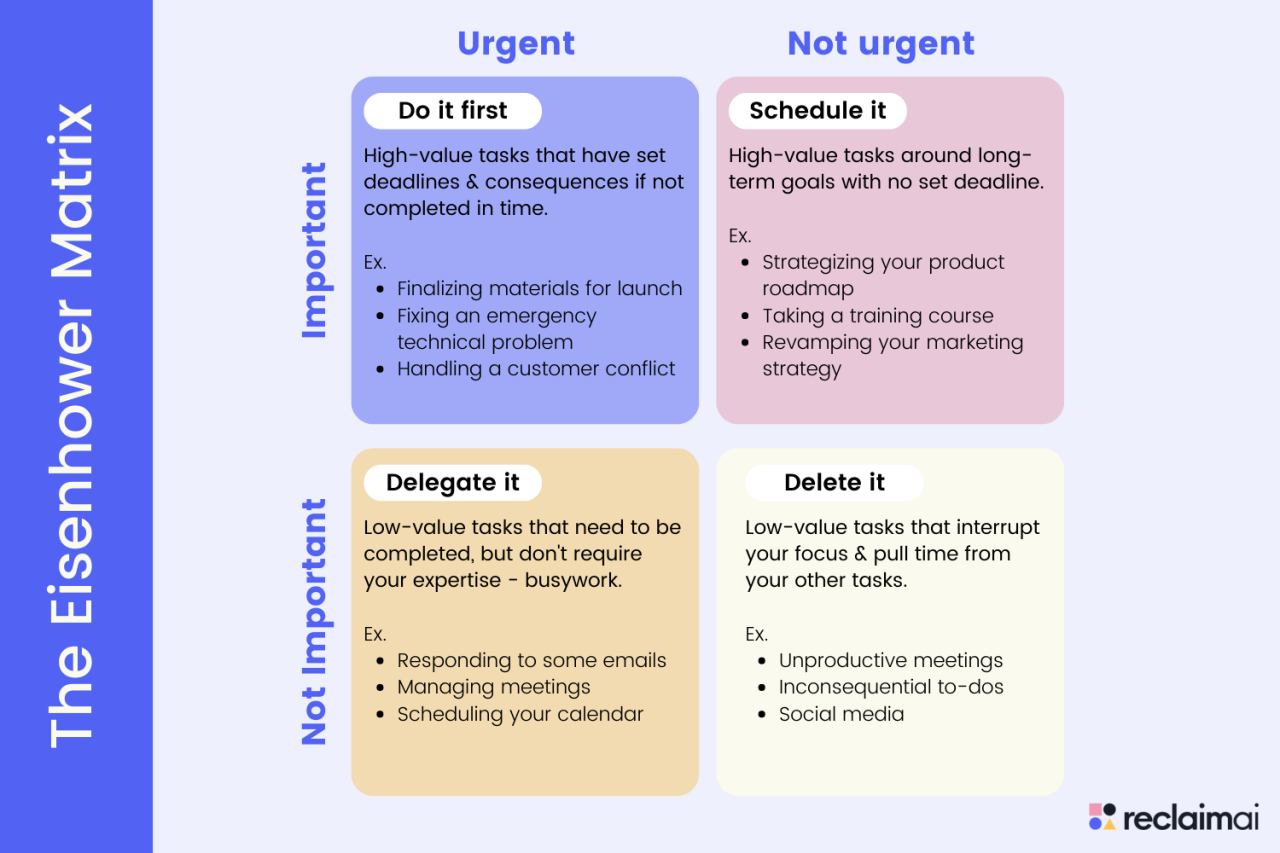
One popular method is the Eisenhower Matrix, which categorizes tasks into four quadrants based on their urgency and importance:
| Quadrant | Label | Description | Examples |
|---|---|---|---|
| I | Urgent and Important | Tasks needing immediate action with significant impact, such as addressing a critical client issue. | |
| II | Not Urgent but Important | Strategic planning, skill development, or relationship building that prevents future crises. | |
| III | Urgent but Not Important | Interruptions like unnecessary meetings or emails that don’t advance core objectives. | |
| IV | Not Urgent and Not Important | Activities like excessive social media browsing that do not serve any long-term purpose. |
Another effective approach is the ABC prioritization method, which involves labeling tasks as A (highest priority), B (medium), or C (low). This simple categorization encourages focus on high-value activities while deferring or delegating less critical ones.
Prioritizing based on clear criteria ensures that your daily efforts are directed toward activities that yield the most significant long-term benefits.
Combining these methods enables a comprehensive assessment that balances urgency with strategic importance, leading to more informed and impactful task selection.
Techniques and Frameworks for Prioritization
Effective prioritization of daily tasks is essential for maximizing productivity and ensuring that critical activities receive appropriate attention. Various frameworks and techniques have been developed to help individuals and teams systematically determine which tasks to focus on first, based on their importance and urgency. Understanding these methods enables better decision-making and more efficient use of time, especially when managing multiple responsibilities.
Implementing suitable prioritization techniques can significantly reduce stress, prevent overlooked deadlines, and contribute to achieving strategic goals consistently. Below are some popular frameworks that can be adapted to daily task management, along with their respective advantages and disadvantages, to guide your selection process.
Popular Prioritization Frameworks
- Eisenhower Matrix: Divides tasks into four quadrants based on urgency and importance, helping to distinguish between what needs immediate attention and what can be delegated or delayed.
- ABC Method: Categorizes tasks into three groups—A (most important), B (moderately important), and C (least important)—facilitating quick prioritization based on significance.
- Pareto Principle (80/20 Rule): Focuses on tasks that will produce the most significant results, typically around 20% of activities that contribute to 80% of outcomes.
- MoSCoW Method: Prioritizes tasks into Must have, Should have, Could have, and Won’t have, enabling clear decision-making on scope and criticality.
- ABCDE Method: Assigns tasks with letter codes from A (very important) to E (least important), with a focus on tackling the highest-priority tasks first.
Pros and Cons of Prioritization Techniques
| Framework | Advantages | Disadvantages |
|---|---|---|
| Eisenhower Matrix |
|
|
| ABC Method |
|
|
| Pareto Principle |
|
|
| MoSCoW Method |
|
|
| ABCDE Method |
|
|
Procedures to Adapt Frameworks for Daily Task Management
To effectively utilize these prioritization frameworks on a daily basis, consider the following structured procedures:
- Identify Tasks Clearly: Begin each day by listing all planned activities, ensuring clarity about what each task entails.
- Select Appropriate Framework: Choose a framework based on the complexity and nature of your tasks. For instance, use the Eisenhower Matrix for urgent versus important tasks or the ABC Method for quick categorization.
- Categorize Tasks: Apply the chosen framework by assigning tasks to respective categories or priority levels. Be honest and objective to maintain effectiveness.
- Allocate Time Accordingly: Focus on high-priority tasks first, scheduling dedicated time blocks for them. Less critical tasks can be deferred or delegated.
- Review and Adjust: At the end of the day, review completed tasks and reassess pending ones. Adjust priorities as needed for the next day, considering new developments or changing circumstances.
- Maintain Consistency: Regular application of these procedures ensures that prioritization becomes an integral part of your daily routine, leading to sustained productivity and better time management.
Planning and Scheduling the Top 3 Tasks
After identifying and prioritizing the three most important tasks each day, the next critical step is to plan and schedule these tasks effectively within your daily routine. Proper scheduling ensures that these tasks receive dedicated focus and are completed efficiently, contributing to overall productivity and goal achievement. Strategic planning prevents tasks from being overlooked or rushed, and it helps create a structured day that balances work and rest.
In this section, we explore how to allocate specific time blocks within your daily schedule for your top priorities, how to break down complex tasks into manageable steps, and provide practical templates to structure your day around these critical activities.
Allocating Time Blocks within Your Daily Schedule
Efficient time management begins with segmenting your day into dedicated time blocks for each prioritized task. Assigning fixed periods to high-priority tasks ensures focused effort and minimizes interruptions. When planning your schedule, consider your natural productivity rhythms—perform demanding tasks when you are most alert, often in the morning or during peak energy periods.
To effectively allocate time, follow these procedures:
- Identify optimal time windows: Review your daily energy levels and schedule demanding tasks during your most productive times.
- Use calendar tools: Utilize digital or physical calendars to block out specific periods exclusively for your top tasks.
- Allow buffer periods: Incorporate short breaks between tasks to reset and maintain focus, especially for longer or more complex tasks.
- Prioritize flexibility: Be adaptable—if unforeseen circumstances arise, reassign time blocks without neglecting your top priorities.
“Time blocking transforms your day into dedicated segments, ensuring that your most important tasks receive the attention they deserve.”
Breaking Down Complex Tasks into Actionable Steps
Large or intricate tasks can be overwhelming and hinder progress if approached all at once. Breaking them down into smaller, manageable steps simplifies execution and boosts confidence. This method facilitates steady progress, reduces procrastination, and makes tracking easier.
Follow these procedures for effective breakdown:
- Define the final objective: Clearly understand what completing the task looks like.
- Segment into sub-tasks: Divide the main task into logical, sequential steps that lead toward the final goal.
- Estimate the time needed: Assign realistic time frames to each sub-task to maintain momentum and avoid delays.
- Prioritize sub-tasks: Arrange steps in order of importance or sequence, focusing on prerequisites first.
- Create actionable checklists: Document steps in a checklist format, enabling you to monitor progress and stay organized.
For example, if your top task is creating a comprehensive report, breaking it down might involve research, outlining, drafting, editing, and final review. Each step becomes a mini-task that can be scheduled separately within your day.
Example Templates for Daily Planning Focusing on Three Main Tasks
Structured templates help streamline your daily planning process, ensuring that your top three tasks are thoughtfully scheduled and executed. Here are two example templates you can adapt to your needs:
| Time Slot | Task | Description |
|---|---|---|
| 8:00 AM – 9:30 AM | Task 1: Market Research | Gather and analyze data related to current market trends and customer preferences. |
| 10:00 AM – 11:30 AM | Task 2: Strategic Planning | Develop strategic objectives based on research findings and set actionable goals. |
| 2:00 PM – 3:30 PM | Task 3: Content Creation | Draft and finalize key content for upcoming presentations or reports. |
Alternatively, a simplified daily planner template can be formatted as follows:
Daily Top Tasks Schedule
- Morning (8:00 – 10:00): Focus on Task 1 with a dedicated, distraction-free environment.
- Late Morning (10:30 – 12:00): Continue or review Task 2, adjusting goals as necessary.
- Afternoon (2:00 – 4:00): Complete or refine Task 3, ensuring all deliverables are on track.
- Wrap-Up (4:30 – 5:00): Review progress, update checklists, and prepare for the next day.
Adopting such templates ensures clarity and discipline in your daily routine, making it easier to stay committed to your top priorities and achieve meaningful progress every day.
Overcoming Common Challenges in Prioritization

Efficient prioritization is essential for maximizing productivity and achieving daily goals. However, individuals often encounter obstacles that hinder their ability to stay focused on their top tasks. Recognizing and addressing these challenges is vital to maintaining consistent progress and ensuring that important tasks are completed effectively within the allocated time frame.Distractions, procrastination, and shifting priorities are among the most prevalent hurdles faced during the prioritization process.
These challenges can divert attention, delay task completion, and diminish overall efficiency, especially when not managed proactively. Developing strategic approaches to counteract these issues can significantly improve your ability to adhere to your daily plans and adapt dynamically to unforeseen circumstances.
Dealing with Distractions and Interruptions
Distractions such as social media, emails, or unexpected interruptions often divert focus away from high-priority tasks. To mitigate this, establishing designated time blocks for deep work, turning off non-essential notifications, and creating a dedicated workspace can help maintain concentration. Utilizing techniques like the Pomodoro Technique, which involves working in focused intervals followed by short breaks, can also enhance focus and reduce susceptibility to interruptions.
Overcoming Procrastination
Procrastination frequently stems from fear of failure, overwhelm, or unclear task objectives. Breaking large tasks into smaller, manageable steps and setting specific, achievable deadlines can foster a sense of progress and reduce avoidance behaviors. Additionally, adopting a mindset of self-compassion and recognizing the importance of each task in achieving larger goals can motivate timely action.
Managing Shifting Priorities
In dynamic work environments, priorities may evolve due to new information or urgent demands. Regular reassessment of your task list is essential to adapt effectively. Implementing a flexible planning approach, such as daily or hourly reviews, allows for real-time adjustments. Using tools like priority matrices or real-time dashboards can aid in visualizing shifts and reallocating focus to the most impactful tasks without losing sight of your core objectives.
Strategies to Stay Committed to Top Three Tasks
Maintaining commitment throughout the day requires deliberate effort and strategic planning. Here are effective strategies to keep yourself aligned with your chosen priorities:
- Set Clear Boundaries: Allocate specific time blocks for your top three tasks and communicate these boundaries to colleagues or team members to minimize interruptions.
- Use Visual Reminders: Place visible cues such as checklists or digital notifications that reinforce your focus on these priorities.
- Monitor Progress: Regularly review your advancement on each task through quick check-ins or progress bars to maintain motivation and accountability.
- Limit Multitasking: Focus on completing one priority at a time to enhance quality and reduce cognitive overload.
- Practice Mindfulness: Mindfulness techniques, including brief meditation sessions, can improve concentration and reduce susceptibility to distractions.
Methods for Dynamic Reassessment and Adjustment of Priorities
Effective prioritization is an ongoing process that benefits from flexibility. Incorporating systematic reassessment methods ensures that your focus remains aligned with shifting requirements. Techniques include:
| Method | Description |
|---|---|
| Daily Review | At the end of each day, evaluate completed tasks and identify new urgent or important items for the following day, adjusting priorities accordingly. |
| Priority Matrix | Utilize tools like the Eisenhower Matrix to categorize tasks based on urgency and importance, facilitating real-time adjustments based on current circumstances. |
| Real-time Feedback | Leverage digital project management tools that allow for immediate updates and re-prioritization as new information becomes available. |
| Stakeholder Input | Engage with team members or stakeholders regularly to understand evolving needs and adjust your task priorities to align with organizational goals. |
“Flexibility in your planning process enables swift adaptation to change, ensuring that your efforts remain aligned with the most critical objectives.”
By adopting these strategies and assessment methods, you can effectively navigate common challenges and sustain a focused, adaptable approach to daily task prioritization, ultimately enhancing productivity and goal achievement.
Tools and Resources for Effective Prioritization
Implementing the right digital tools and resources can significantly enhance your ability to prioritize tasks efficiently. Leveraging technology not only streamlines the process but also provides clarity, accountability, and flexibility, enabling you to stay on top of your daily objectives with greater ease.
This section explores a selection of popular tools designed to support task prioritization, compares their key features, and offers insights into integrating them seamlessly into your daily routines for optimal task management.
Digital Tools and Apps Supporting Task Prioritization
Various digital platforms have been developed to assist individuals and teams in organizing and prioritizing their tasks effectively. These tools range from simple to highly sophisticated, offering functionalities such as task categorization, deadline setting, collaboration, and progress tracking. Using these tools consistently can help ensure that your top priorities receive the attention they deserve, reducing stress and increasing productivity.
- Trello: Visual project management tool using boards, lists, and cards for task organization and prioritization. It supports collaboration and integrates with numerous apps.
- Asana: Task and workflow management platform that enables setting priorities, deadlines, and dependencies, making it easier to track progress on key tasks.
- Todoist: Simple yet powerful task manager with priority levels, labels, and filters to help you focus on the most important tasks daily.
- Microsoft To Do: Integrates with Microsoft 365, offering task lists, due dates, and reminders, ideal for personal and professional task management.
- Notion: All-in-one workspace supporting customizable task databases, calendars, and prioritization frameworks suited for personal and team use.
- ClickUp: Offers task management, goal tracking, and time management features to help organize and prioritize complex projects efficiently.
Comparison of Popular Planning Tools
To select the most suitable tool, understanding their core features and differences is essential. The following table highlights key aspects of these platforms to facilitate an informed choice based on your specific needs and preferences.
| Feature | Trello | Asana | Todoist | Microsoft To Do | Notion | ClickUp |
|---|---|---|---|---|---|---|
| Ease of Use | High; intuitive visual interface | High; user-friendly with extensive features | Very high; minimal learning curve | High; integrated with Microsoft ecosystem | Moderate; highly customizable | Moderate; feature-rich but complex |
| Task Prioritization | Yes; labels and due dates | Yes; custom fields and dependencies | Yes; priority levels and filters | Yes; importance flags and deadlines | Yes; customizable databases and tags | Yes; custom statuses and views |
| Collaboration Features | Yes; team boards, comments, attachments | Yes; team projects, comments, file sharing | Limited; primarily individual use | Limited; mainly personal use | Yes; shared workspaces, comments | Yes; chat, comments, shared dashboards |
| Integration Capabilities | Extensive; integrates with Slack, Google Drive, etc. | Wide; supports numerous apps and tools | Moderate; integrates with email and calendar | Deep; seamless with Microsoft 365 apps | Very extensive; supports APIs and third-party services | Broad; supports various integrations and APIs |
| Pricing | Free tier available; paid plans with advanced features | Free basic plan; premium options for teams | Freemium; premium adds features | Free; premium upgrades available | Free; paid plans for added storage and features | Freemium; premium plans unlock advanced features |
Integrating Tools into Daily Routines for Better Task Management
Effective prioritization hinges on consistent use of these digital tools within your daily workflow. Establishing routines that incorporate these platforms can help you stay organized and focused on your top priorities.
Implement a habit of reviewing your task list at the start and end of each day. Use notifications and reminders to keep deadlines in check, and regularly update task statuses to reflect progress. Integrate the chosen tool with your calendar to synchronize your schedule and avoid overcommitment.
Begin each day by identifying your top three tasks using your preferred platform. Block dedicated time slots for these tasks, ensuring they receive undivided attention. At the end of the day, review completed tasks and plan for the next day, adjusting priorities as needed. Consistency in this routine enhances your ability to manage priorities effectively and cultivates a disciplined approach to daily task management.
Measuring Success and Improving Prioritization Skills

Effective prioritization is a dynamic process that requires ongoing assessment and refinement. Tracking progress and reflecting on past decisions enable individuals and teams to enhance their ability to select tasks that truly maximize productivity and goal achievement. Establishing clear success metrics and regular review practices ensures continuous improvement in prioritization skills, leading to more efficient and impactful work outcomes.Evaluating the effectiveness of prioritization efforts involves analyzing specific metrics that reflect both productivity and strategic alignment.
Reflection practices contribute to developing a deeper understanding of decision-making patterns, helping identify areas for adjustment and growth. By systematically reviewing and refining prioritization techniques, individuals can adapt to changing circumstances and improve overall task management strategies.
Metrics for Evaluating Prioritization Effectiveness
Understanding measurable indicators allows for objective assessment of how well prioritization efforts are performing. These metrics should be tailored to individual or organizational goals to ensure relevance and clarity.
Key metrics include:
- Task Completion Rate: Tracks the percentage of prioritized tasks completed within a set timeframe, indicating efficiency and focus.
- Urgency vs. Importance Balance: Measures the extent to which tasks align with strategic goals versus urgent but less critical activities, promoting better decision-making.
- Time Allocation Accuracy: Compares estimated versus actual time spent on top-priority tasks, highlighting estimation skills and process effectiveness.
- Goal Alignment Score: Assesses how well completed tasks contribute to overarching objectives, ensuring priorities remain aligned with long-term vision.
- Deadline Adherence: Evaluates consistency in meeting deadlines for high-priority tasks, reinforcing discipline and planning accuracy.
“Regularly tracking these metrics enables a data-driven approach to improving prioritization, ensuring efforts are aligned with desired outcomes.”
Creating Reflective Practices for Task Selection Refinement
Reflection is essential for recognizing strengths and identifying areas for improvement. Developing structured reflective routines helps optimize task selection processes over time.
Effective reflective practices include:
- Post-Task Review: After completing each day or week, analyze which tasks were prioritized, their outcomes, and any obstacles faced. This helps identify patterns of success or misalignment.
- Journaling and Documentation: Maintaining a journal of daily prioritization decisions provides insight into decision-making rationales and their effectiveness, facilitating pattern recognition over time.
- Peer or Mentor Feedback: Engaging with colleagues or mentors for feedback on task prioritization decisions fosters diverse perspectives and identifies blind spots.
- Root Cause Analysis: When tasks are deferred or delayed, investigate underlying causes—be it misjudgment of importance, time misestimation, or external distractions—and adjust strategies accordingly.
“Regular reflection transforms experiences into actionable insights, refining the skill of prioritization through continuous learning.”
Procedures for Setting Review Sessions
Establishing routine review sessions at different intervals ensures that prioritization strategies evolve with changing circumstances. These reviews help in calibrating priorities, recognizing achievements, and addressing challenges.
Recommended review procedures include:
- Daily Reviews: Spend 10-15 minutes at the end of each workday assessing which tasks were completed, what was deferred, and why. Use this insight to adjust the next day’s priorities accordingly.
- Weekly Reviews: Allocate 30 minutes to an hour at the end of the week to evaluate overall task management, review goals achieved, and identify recurring challenges. Document lessons learned and set refined priorities for the upcoming week.
- Monthly Reviews: Conduct comprehensive assessments to measure progress against long-term goals, analyze patterns in prioritization effectiveness, and recalibrate strategies as needed. Incorporate feedback from team members or supervisors to enhance decision-making frameworks.
Effective review sessions should be accompanied by documentation—such as checklists, progress logs, or dashboards—that facilitate tracking improvements over time and support data-driven adjustments.
Final Conclusion
In conclusion, learning how to prioritize three important tasks each day empowers you to work smarter, not harder. By applying proven frameworks, utilizing the right tools, and regularly reviewing your progress, you can continually refine your prioritization skills. This dedicated approach leads to sustained success, reduced stress, and a more balanced and fulfilling work life.